
 Contact
 How to shop

Delivery
Shopping guide
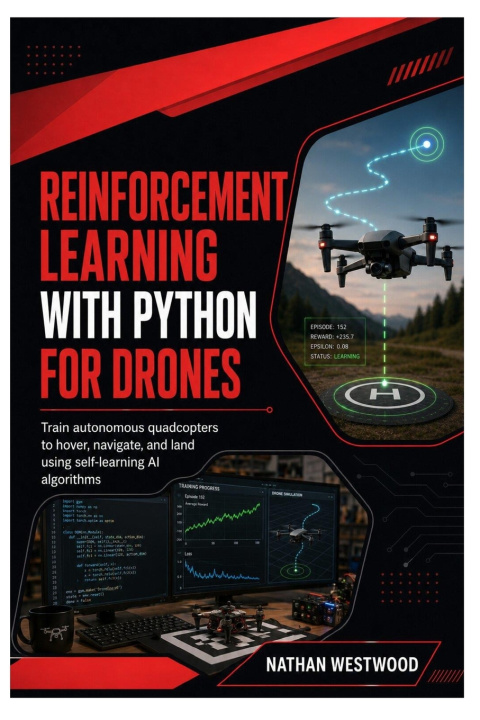
Reinforcement Learning with Python for Drones
Train Autonomous Quadcopters to Hover, Navigate, and Land Using Self-Learning AI Algorithms
 English
 46 b
Up to 30 days for returns

Teach a simulated quadcopter to hover, navigate, avoid obstacles, and land through repeated practice.
A quadcopter is easy to admire but difficult to control. Every motor change affects altitude, tilt, speed, direction, and stability. Wind, sensor noise, changing weight, and timing errors make the problem even harder.
Reinforcement Learning with Python for Drones shows you how to train autonomous drone behaviours in simulation before moving cautiously toward real hardware.
Using Python, NumPy, Gymnasium, PyBullet, Matplotlib, and Stable-Baselines3, this beginner-friendly guide will help you:
- Understand how quadcopters move, hover, turn, and respond to thrust
- Learn the reinforcement-learning loop of observations, actions, rewards, steps, and episodes
- Create a clean Python development environment for repeatable experiments
- Build a reusable simulated drone environment with Gymnasium and PyBullet
- Design useful observation spaces, action spaces, reward functions, and termination rules
- Train a simple altitude-control agent with Q-learning
- Move from Q-tables to neural-network-based learning
- Train a hovering agent with Proximal Policy Optimisation, or PPO
- Improve hovering under varied starting positions, sensor noise, wind, and mass changes
- Train a drone to navigate toward waypoints
- Teach an agent to avoid static and random obstacles
- Build an autonomous landing task with alignment, descent, touchdown, and failure handling
- Use domain randomisation to reduce the gap between simulation and reality
- Evaluate results using hovering error, navigation success, collision rates, and landing accuracy
- Compare DQN, PPO, and SAC for drone-control tasks
- Save models, organise logs, plot results, and make experiments reproducible
- Move cautiously through software-in-the-loop, bench testing, manual override, emergency stop, and controlled flight preparation
You do not need previous robotics or reinforcement-learning experience. The book introduces the required Python concepts as they become necessary, including variables, functions, classes, loops, arrays, file paths, and structured project folders.
The four main flight projects build on one another: hovering, waypoint navigation, obstacle avoidance, and autonomous landing. Each project is trained, tested, measured, and improved before becoming part of the next stage.
Safety remains central throughout. You will not place an untested learning policy in direct control of a powered aircraft. Training begins in simulation, and later hardware transfer is treated as a staged process using conservative limits, propeller-off bench checks, flight boundaries, manual override, emergency stop, and local aviation rules.
Build the learning environment, train the agent, measure the result, and develop drone-control skills one safe experiment at a time.

About the book
English

Give this book today
It's easy
1 Add to cart and choose Deliver as present at the checkout 2 We'll send you a voucher 3 The book will arrive at the recipient's addressHi! I'm Libroamiko, your book advisor.
How can I help you?