
 Contact
 How to shop
Delivery
Shopping guide
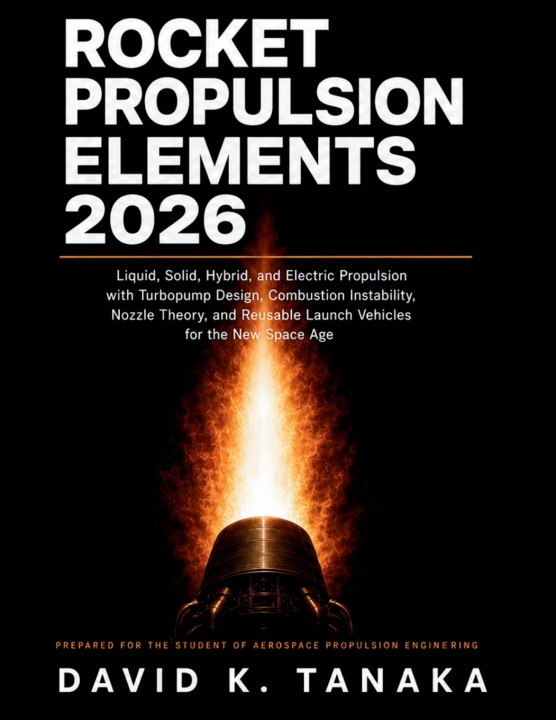
ROCKET PROPULSION ELEMENTS 2026
Liquid, Solid, Hybrid, and Electric Propulsion with Turbopump Design, Combustion Instability, Nozzle Theory, and Reusable Launch Vehicles for the New Space Age
 English
 272 b
272 b
 New
New
Up to 30 days for returns
You might also be interested in




 /
/
 Hardback
 130.71
€
130.71
€

The Complete Modern Textbook for Rocket Propulsion Engineers
If you are studying aerospace engineering, preparing for a career at SpaceX, Rocket Lab, or Blue Origin, or teaching yourself propulsion from scratch - this is the book the industry has been waiting for.
Rocket Propulsion Engineering is a comprehensive, university-level textbook covering every major propulsion technology in a single volume: liquid bipropellant engines, solid rocket motors, hybrid propulsion, and electric propulsion systems. Written for the New Space Age, it covers the technologies actually driving today's launch vehicle industry - including reusable engine design, full-flow staged combustion, additive manufacturing, green propellants, rotating detonation engines, and Hall-effect thrusters.
WHAT MAKES THIS TEXTBOOK DIFFERENT
Most propulsion texts are over a decade old - written before SpaceX's Raptor engine, before Rocket Lab's Rutherford, before Hall thrusters became standard equipment on commercial satellites. This book covers what those texts do not: full-flow staged combustion cycles, reusable propulsion design and refurbishment criteria, additive manufacturing of thrust chambers and turbopumps, green ionic liquid propellants replacing toxic hydrazine, and electric propulsion for megaconstellations.
22 CHAPTERS ACROSS FOUR BLOCKS
Block A - Foundations: Thermodynamics of rocket nozzles, isentropic flow, thrust equation, specific impulse, characteristic velocity, and thrust coefficient.
Block B - The Ideal Rocket: Rocket equation, gravity and drag losses, trajectory analysis, combustion thermochemistry, NASA-CEA analysis, propellant performance metrics, and nozzle optimisation.
Block C - Propulsion Technology: Six chapters on liquid propulsion covering engine cycles, propellant selection, thrust chamber and injector design, combustion instability (Rayleigh criterion, tau-n model, chugging, POGO), turbopump design (specific speed, impeller, turbine, inducer, cavitation, bearings), and engine controls. Four chapters on solid propulsion covering Vieille's law, grain geometry, propellant formulation, combustion stability, motor case structural design, and nozzle materials. Full chapters on hybrid and electric propulsion covering resistojet, arcjet, gridded ion thrusters, Hall-effect thrusters, and MPD systems.
Block D - Systems and Integration: Trajectory and staging optimisation, propulsion testing and qualification, advanced topics including rotating detonation engines, nuclear thermal propulsion, reusable launch vehicles, and in-space propellant depots. Closes with a complete capstone design project working two engines from requirements to hardware.
BUILT FOR LEARNING
Every chapter includes fully worked examples in GIVEN-FIND-SOLUTION-ANSWER format with every number independently verified, 15 to 20 end-of-chapter problems graded from fundamental to open-ended design, and annotated further-reading references pointing to the primary sources behind every topic.
WHO THIS BOOK IS FOR
Undergraduate and graduate aerospace engineering students, engineers entering the space industry who need to build propulsion knowledge fast, professors seeking a current and comprehensive propulsion textbook, and self-study learners who want to understand how rocket engines actually work.
Prerequisites are introductory thermodynamics and fluid mechanics only. Compressible flow is derived from first principles in Chapter 3.
If you have been working from an outdated propulsion text - or searching for a single book that covers liquid, solid, hybrid, and electric propulsion with the depth each technology deserves - your search ends here.


About the book
English

Give this book today
It's easy
1 Add to cart and choose Deliver as present at the checkout 2 We'll send you a voucher 3 The book will arrive at the recipient's addressHi! I'm Libroamiko, your book advisor.
How can I help you?