
 Contact
 How to shop
Delivery
Shopping guide
 English
 294 b
294 b
Customers also purchased




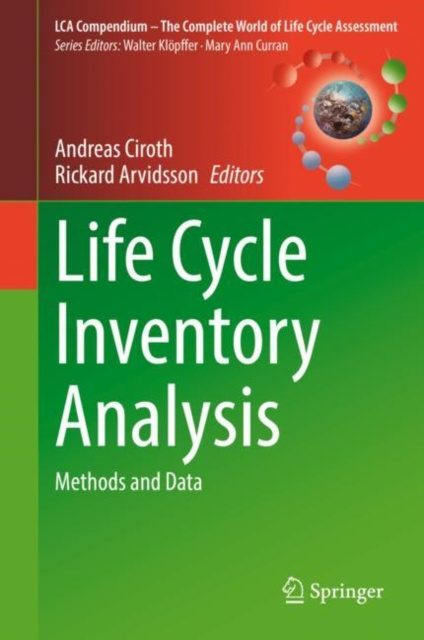
Life Cycle Inventory (LCI) Analysis is the second phase in the Life Cycle Assessment (LCA) framework. Since the first attempts to formalize life cycle assessment in the early 1970, life cycle inventory analysis has been a central part. Chapter 1 "e;Introduction to Life Cycle Inventory Analysis"e; discusses the history of inventory analysis from the 1970s through SETAC and the ISO standard. In Chapter 2 "e;Principles of Life Cycle Inventory Modeling"e;, the general principles of setting up an LCI model and LCI analysis are described by introducing the core LCI model and extensions that allow addressing reality better. Chapter 3 "e;Development of Unit Process Datasets"e; shows that developing unit processes of high quality and transparency is not a trivial task, but is crucial for high-quality LCA studies. Chapter 4 "e;Multi-functionality in Life Cycle Inventory Analysis: Approaches and Solutions"e; describes how multi-functional processes can be identified. In Chapter 5 "e;Data Quality in Life Cycle Inventories"e;, the quality of data gathered and used in LCI analysis is discussed. State-of-the-art indicators to assess data quality in LCA are described and the fitness for purpose concept is introduced. Chapter 6 "e;Life Cycle Inventory Data and Databases"e; follows up on the topic of LCI data and provides a state-of-the-art description of LCI databases. It describes differences between foreground and background data, recommendations for starting a database, data exchange and quality assurance concepts for databases, as well as the scientific basis of LCI databases. Chapter 7 "e;Algorithms of Life Cycle Inventory Analysis"e; provides the mathematical models underpinning the LCI. Since Heijungs and Suh (2002), this is the first time that this aspect of LCA has been fundamentally presented.In Chapter 8 "e;Inventory Indicators in Life Cycle Assessment"e;, the use of LCI data to create aggregated environmental and resource indicators is described. Such indicators include the cumulative energy demand and various water use indicators. Chapter 9 "e;The Link Between Life Cycle Inventory Analysis and Life Cycle Impact Assessment"e; uses four examples to discuss the link between LCI analysis and LCIA. A clear and relevant link between these phases is crucial.


About the book
English

Give this book today
It's easy
1 Add to cart and choose Deliver as present at the checkout 2 We'll send you a voucher 3 The book will arrive at the recipient's addressYou might also be interested in

Hi! I'm Libroamiko, your book advisor.
How can I help you?